
Tricky Spaces Vol. 2
#notmyclientsspace
Friday June 12

Not my client’s space
Let’s tackle a design dilemma together
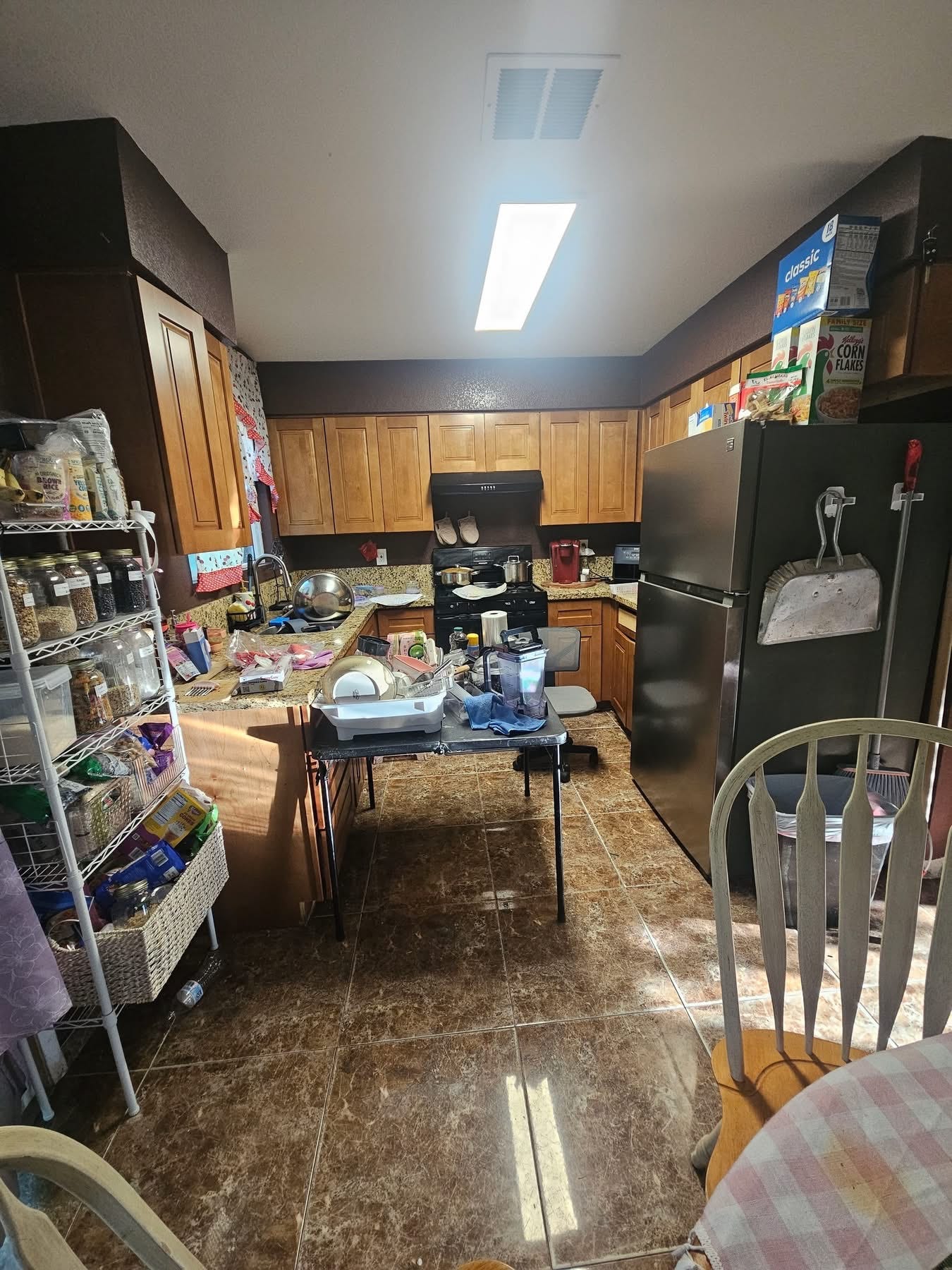
This is another one of those rooms from a Facebook Group where the person who has uploaded the image is asking for help and advice on how to make it better.
It can be tempting, at least for me, to look at some spaces and feel overwhelmed, like the only choice is starting from scratch. That’s not a reality for everyone, and, in many cases, it can be wasteful if it’s just coming down to a matter of taste, and not true function.
As we look at this space, I’m asking three questions:
What are the challenges and limitations of the space?
Where are their opportunities?
How do we improve the design and functionality?
Challenges and limitations
It’s very brown. Brown floor. Brown cabinets. Brown soffit. Brown backsplash.
It’s dark. It’s actually challenging to tell what time of day it is because the space gets almost no natural light. Add to that the singular strip light in the middle of the ceiling, and it’s no wonder it feels so dark.
It’s lacking storage. The additional table, freestanding shelves, and food stored above the fridge suggest the cabinets in the kitchen are insufficient.
There’s a lot we’re seeing because there isn’t space for it - trash can, dustpan and broom, and there’s a drying rack on the card table.
Finding the opportunities
Let’s assume this is a rental. In rental spaces there’s a limit to what you can do, but that doesn’t mean you can’t change things dramatically. It’s true that architecture and interior design are the bedrock of good design, but this is where you lean heavilty into decorating and lighter, less-permanent choices.
We can improve the light going into the room, and we can brighten with peel and stick wallpaper (and even peel and stick flooring, although a rug would work too). We can also change the freestanding furniture, opting for pieces that will enhance functionality, not hinder it, and look beautiful doing so.
Improving design and functionality
For this, we turn to New York City apartments for inspiration. It’s true that this kitchen isn’t nearly as small as many of these tend to be, but there are still lessons we can learn from those tiny kitchens and implement here, as New Yorkers are some of the best at making their small spaces work hard and look beautiful.


5 quick lessons in clever design from New York City kitchens
Use every surface; even a window frame is valuable real estate.
Storage that isn’t hidden is still storage, just make it beautiful.
The right furniture goes a long way.
There’s always more room than you think.
When in doubt, add charm and whimsy.
I love that in the images above, every inch of ceiling hight is used, there are things on top of things, or behind things, and that these are not minimalist spaces.
Here’s what I’d do:
Lose the card table and the chair with it. It’s blocking entry into the kitchen, blocking the drawers behind it, and probably preventing the fridge from opening properly. To make space for drying dishes, a roll out drying mat could sit over the sink once dishes were done, or an under-cabinet mounted one could work too.
Lose the window treatment (in its entirety). It doesn’t match anything and it’s blocking natural light.
Use a light-coloured peel and stick wallpaper above the backsplash to lighten it. Nothing brown or dark; something humble and simple with a repeated pattern that wouldn’t interfere with the countertop. Use it around the entire perimeter above the backsplash, and depending on budget, use it on the kitchen soffit too.
Store unused pots and pans IN the oven; this is a genius small-space apartment-dweller hack, and it frees up the stove.
Go through cabinets and drawers. I may be wrong in saying that I don’t think all of them are full, but I don’t think I am. Decluttering and organizing go a long way in increasing the look, sense, and feel of a space.
Lose the wire shelves, and replace them with a tall hutch (the tallest ever!). Bonus points if it is glass fronted. Most hutches use unpainted wood, which is brown, but if it is glass fronted, a bright fabric can be run behind the glass to brighten and lighten the effect of more brown in the brown room. The hutch could take all the items on the white shelving rack (and sit in the same spot it occupied), but would keep them out of sight; more contained, cleaner-looking.
Get a lighter kitchen rug. It would need to be as big as possible, taking up most of the u-shaped kitchen floor. A peel and stick tile would work here, but is more laborious.
Add framed art in white matts on the soffit. Ideally, here I’d recommend the same shape and size, spaced out a little on the soffit that runs the perimeter of the room. White = bright!
Remove the dustpan and brush from the side of the fridge, replace them with hanging pan storage, or art, or both. They’d still be needed, obviously, but this is when I’d move them so they were either in a dedicated closet, assuming one exists, or tucked neatly between the hutch and the last bank of cabinets opposite the fridge.
Speaking of the fridge, I’d also recommend taking the foods on top out of their bulky boxes and placing them into baskets above the fridge. The cornflakes come in a bag and the chips are individually wrapped, so putting them inside baskets would neaten up the top of the fridge and work functionally.
Assuming the person living in the space needs a chair and table in order to complete their tasks in the kitchen with ease, a very small tulip table and stool would work just as well without taking up as much space.
Some landlords are fine with paint, some not so much. If it’s the former, paint, lighter and brighter; if not, stick with peel and stick wallpaper.
Swap the trashcan for something cute (like this), if it has to be seen it should be closed, and pretty.
Despite what the image might show us, a brighter, happier, more functional kitchen is possible without a sledgehammer and ripped up tile. Even brown on brown kitchens can become places full of light and charm.
Signing off for this week! If you’re looking for more, check out the blog, the podcast, or find us on Instagram and Pinterest.